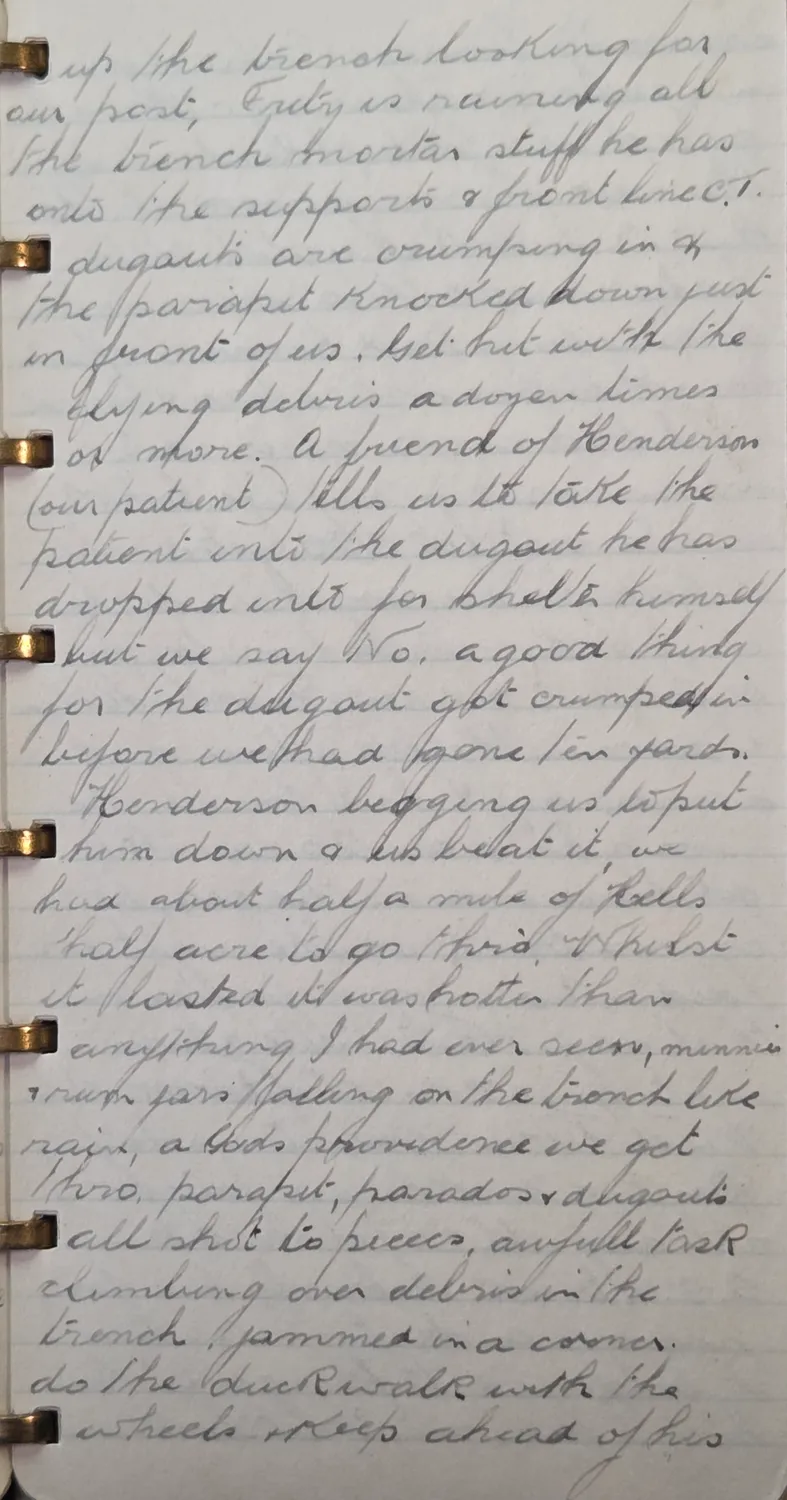
up the trench looking for our post, Fritz is raining all the trench mortar stuff he has onto the supports & front line C.T. dugouts are crumping in & the parapet knocked down just in front of us. Get hit with the flying debris a dozen times or more. A friend of Henderson (our patient) tells us to take the patient into the dugout he has dropped into for shelter himself but we say No. a good thing for the dugout got crumped in before we had gone ten yards. Henderson begging us to put him down & us beat it we had about half a mile of Hells half acre to go thro. Whilst it lasted it was hotter than anything I had ever seen, minnies & rum jars falling on the trench like rain, a Gods providence we get thro. parapet, parados & dugouts all shot to pieces, awful task climbing over debris in the trench jammed in a corner, do the duckwalk with the wheels & keep ahead of his
▸ Where was he?
▸ The war at this time
Trench raids at Vimy
Trench raids were a regular feature of the Vimy sector in early 1917. Parties of infantry (typically 20 to 200 men) would cross no man's land under cover of a brief artillery barrage, enter enemy trenches, capture prisoners for interrogation, destroy dugouts, and withdraw. The entire operation might last only 15 to 30 minutes. For the stretcher-bearers, the aftermath was the critical period: casualties had to be evacuated through communication trenches under the German counter-barrage that inevitably followed. Stretcher-bearers in the Canadian Corps received limited formal medical training, typically a St. John Ambulance first-aid course covering splinting, tourniquets, and wound dressing, but little preparation for the physical demands of trench evacuation. Each bearer squad of four men carried a loaded stretcher weighing roughly 150 pounds through trenches barely wide enough for two men to pass. Casualty rates among bearers were consistently among the highest of any medical role: during active operations on the Western Front, field ambulance units could expect 30 to 50 percent casualties in a single tour. Once a wounded man was collected, the evacuation chain followed a fixed sequence. Bearers carried the patient to a Regimental Aid Post (RAP) at or near the front line, where a medical officer applied emergency treatment. From there, the patient moved rearward to an Advanced Dressing Station (ADS), usually within a few hundred yards of the trenches, for stabilization. Serious cases then continued by motor ambulance to a Casualty Clearing Station (CCS) several miles behind the lines, where surgery could be performed. For a man wounded during a night raid, this chain from front-line collection to operating table could take anywhere from four to twelve hours depending on the intensity of shelling along the evacuation route.