← Previous

Tuesday, February 13, 1917

Page 68
Next →

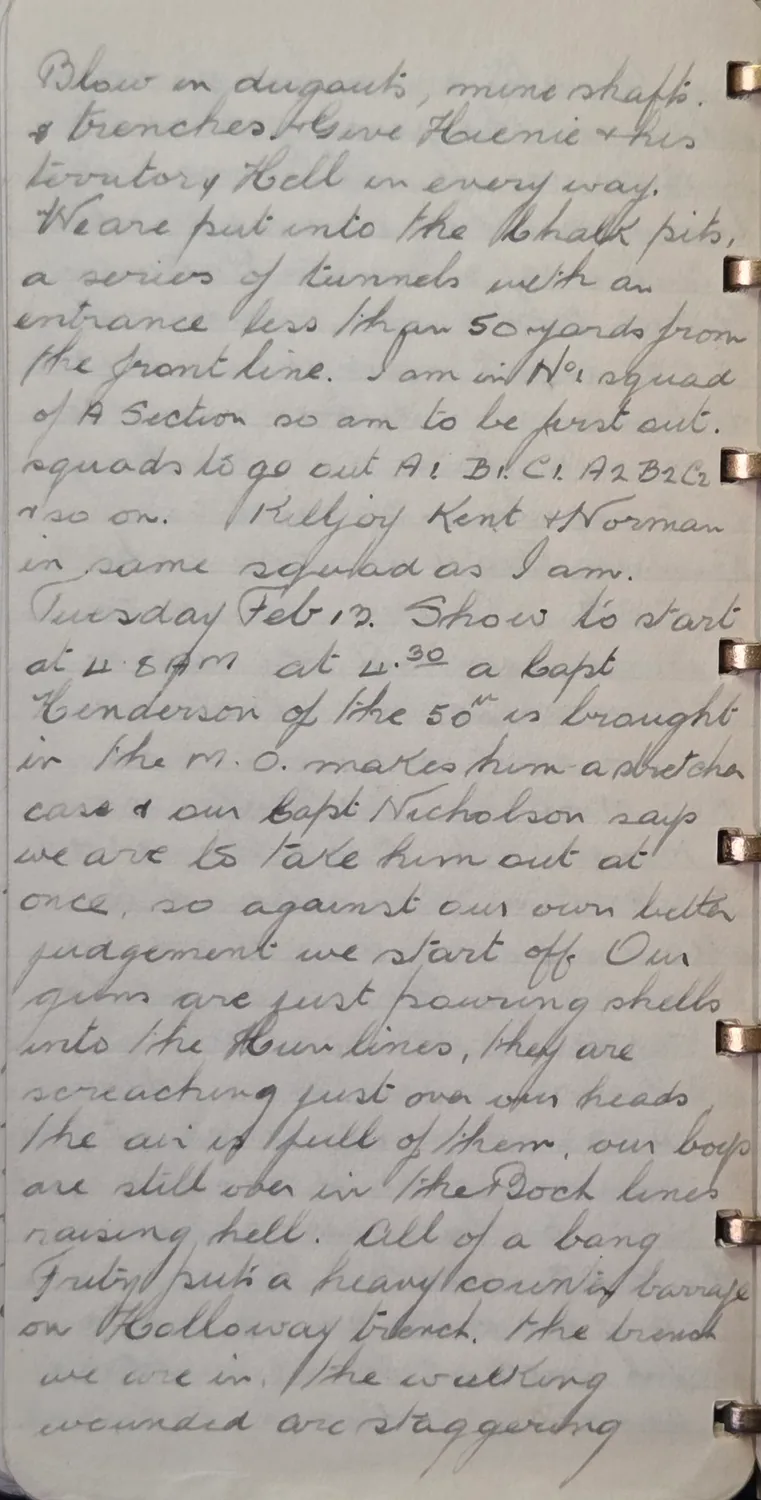
Blow in dugouts, mine shafts. & trenches &Give Heinie & his territory Hell in every way. We are put into the Chalk pits, a series of tunnels with an entrance less than 50 yards from the front line. I am in No 1 squad of A Section so am to be first out. squads to go out A1 B1 C1 A2 B2 C2 & so on. Killjoy Kent & Norman in same squad as I am.

Tuesday Feb 13. Show to start at 4.45 AM at 4.30 a Capt Henderson of the 50th is brought in the M.O. makes him a stretcher case & our Capt Nicholson says we are to take him out at once. so against our own better judgement we start off Our guns are just pouring shells into the Hun lines, they are screeching just over our heads the air is full of them. our boys are still over in the Boch lines raising hell. All of a bang Fritz puts a heavy counter barrage on Holloway trench, the trench we are in. the walking wounded are staggering
Where was he?
The war at this time

Canadian trench raids on the Vimy front, February 1917

In the weeks before the Battle of Vimy Ridge, the Canadian Corps conducted an intensive series of trench raids against the German positions on the ridge. These were not random harassment. Each raid had specific objectives: to cut and test the German wire, to capture prisoners whose unit insignia and testimony would identify which German divisions held each sector, and to probe the depth and layout of the German trench system. The intelligence gathered shaped the detailed assault plan for April 9. Raids in this period were typically company-strength affairs involving 100 to 200 men, preceded by brief but intense artillery bombardments designed to suppress the German garrison and cut wire lanes. The February 1917 raids on the Vimy front were among the most costly of the entire pre-assault period. German defenders had deepened their dugouts and strengthened their counterattack procedures, and the raids frequently drew heavy retaliatory barrages onto the Canadian jumping-off trenches and communication routes. The counter-barrages were specifically aimed at the trenches behind the raiders to prevent reinforcement and to catch stretcher parties and walking wounded funnelling back through narrow communication trenches. For the medical personnel positioned in tunnel systems and forward aid posts, a major raid meant a sudden surge of casualties arriving under shellfire, often dozens of wounded within the first hour. The Chalk Pits tunnel system, where forward medical posts were established, sat within the network of subterranean passages that the Canadian Corps had expanded throughout the winter. These tunnels served as sheltered routes to the front line and as staging areas for raiding parties, but their entrances were well known to German artillery observers. The 50th Battalion (Calgary) was one of several Alberta and Manitoba units rotated through the Vimy sector during this period, and its officers and men frequently participated in or supported the raiding programme.