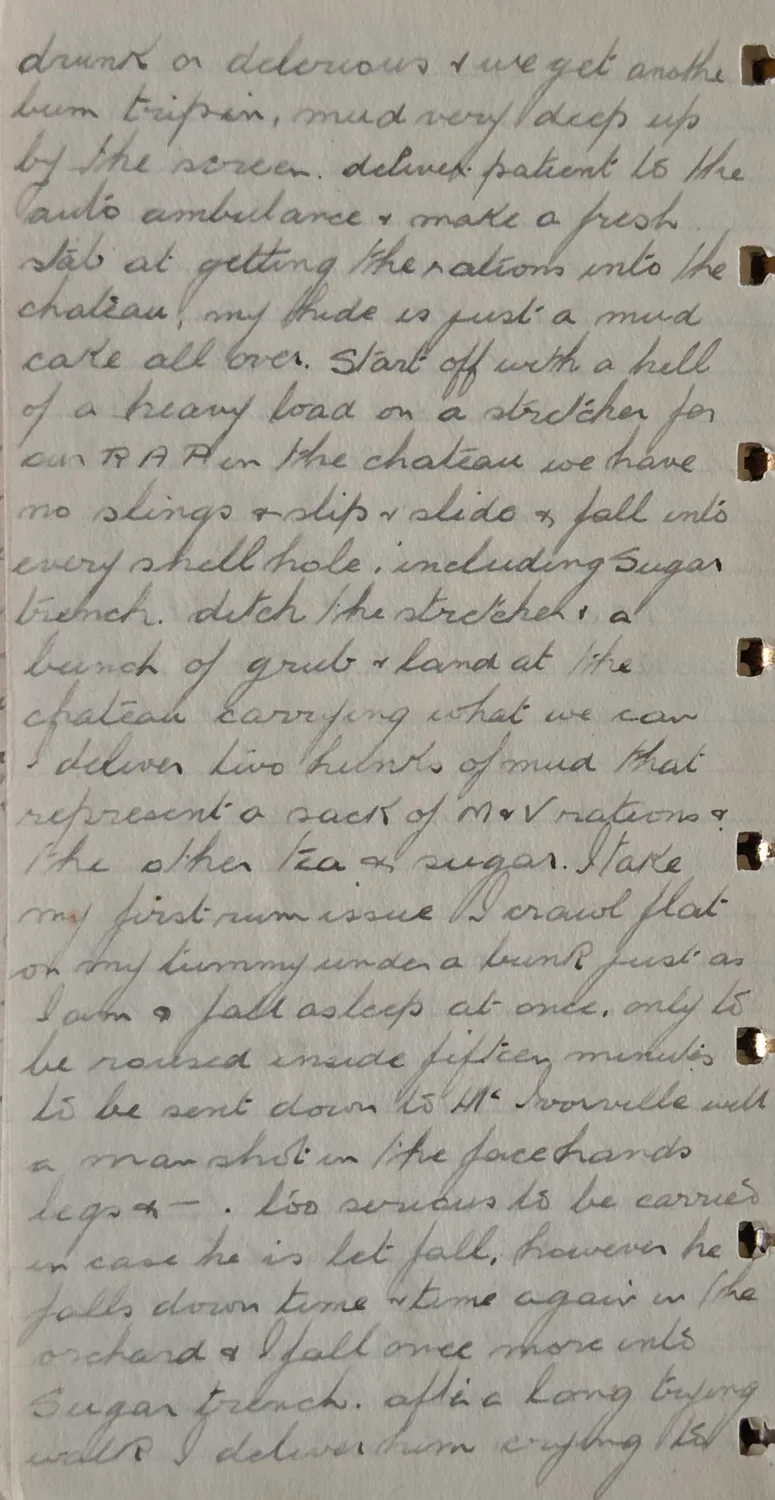
drunk or delirious & we get another bum trip in, mud very deep up by the screen. deliver patient to the auto ambulance & make a fresh stab at getting the rations into the chateau, my hide is just a mud cake all over. Start off with a hell of a heavy load on a stretcher for our R.A.P in the chateau we have no slings & slip & slide & fall into every shell hole, including Sugar trench. ditch the stretcher & a bunch of grub & land at the chateau carrying what we can & deliver two hunks of mud that represent a sack of M & V rations & the other tea & sugar. Take my first rum issue I crawl flat on my tummy under a bunk just as I am & fall asleep at once. only to be roused inside fifteen minutes to be sent down to Mc’Inorville with a man shot in the face hands legs & -. too serious to be carried in case he is let fall. however he falls down time & time again in the orchard & I fall once more into Sugar trench. after a long trying walk I deliver him crying to
▸ Where was he?
▸ The war at this time
The casualty evacuation chain and its collapse
The British medical evacuation system was designed as a chain of stages. A wounded man was first treated at the Regimental Aid Post (R.A.P.) by his battalion's medical officer, then carried by stretcher-bearers to an Advanced Dressing Station run by a field ambulance, then moved rearward by horse or motor ambulance to a Casualty Clearing Station. The regulation establishment called for 32 stretcher-bearers per infantry battalion and additional bearer squads within each field ambulance. In practice, on the Somme by October 1916, these numbers had been gutted by casualties. Stretcher-bearers suffered disproportionately high losses: they worked in the open, often under fire, and could not take cover while carrying a patient. A loaded stretcher weighed roughly 150 pounds and required four bearers in good conditions; in the mud of the Somme, six or even eight men were sometimes needed for a single carry, and the journey from an R.A.P. to a dressing station that was mapped at 800 yards could take four hours. The formal system assumed that walking wounded would make their own way rearward, freeing bearers for stretcher cases. But men with facial injuries, shattered hands, or multiple wounds often could not navigate alone through the dark, cratered ground. Field ambulance personnel had to escort these patients individually, a massive drain on an already depleted workforce. When bearers ran short, wounded men simply waited, sometimes for a day or more, at exposed aid posts. The Canadian Expeditionary Force drew heavily from communities where the temperance movement had deep roots. Manitoba had enacted prohibition in March 1916, just months before these men shipped to France. Many soldiers arrived at the front with sincere convictions against alcohol. The army's daily rum ration (approximately one-sixteenth of a pint of overproof navy rum, issued at the discretion of the commanding officer) was a point of genuine moral conflict for these men, not merely a matter of taste. The decision to accept the rum was often experienced as a private capitulation, a marker of how far the war had pushed a man from his peacetime self.