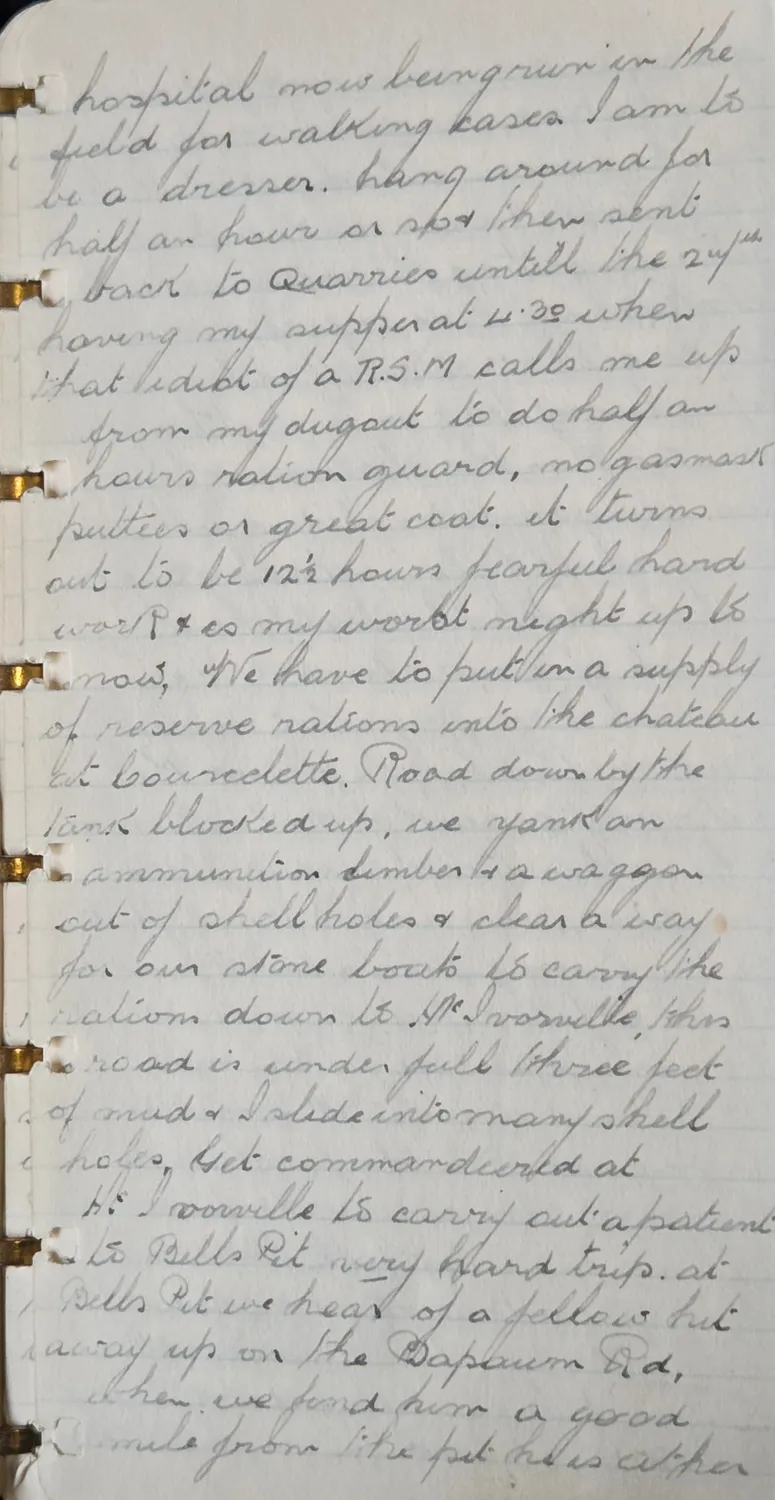
hospital now being run in the field for walking cases I am to be a dresser. hang around for half an hour or so & then sent back to Quarries until the 24th having my supper at 4.30 when that idiot of a R.S.M calls me up from my dugout to do half an hours ration guard, no gasmask puttees or great coat. it turns out to be 12½ hours fearful hard work & as my worst night up to now, We have to put in a supply of reserve rations into the chateau at Courcelette. Road down by the tank blocked up, we yank an ammunition limber & a waggon out of shell holes & clear a way for our stone boats to carry the rations down to Mc’Inorville, this road is under full three feet of mud & I slide into many shell holes, Get commandeered at Mc’Inorville to carry out a patient to Bells Pit. very Hard trip. at Bells Pit we hear of a fellow hit away up on the Bapaume Rd. when we find him a good ½ mile from the pit he is either
▸ Where was he?
▸ The war at this time
The Somme supply crisis and field ambulance labour
Field ambulance personnel were trained and designated for medical duties: collecting wounded, staffing dressing stations, and evacuating casualties rearward. Under the establishment tables, they were not supposed to be tasked with carrying rations or ammunition. However, by late October 1916, the manpower crisis on the Somme had become so severe that every available body was pressed into supply work. Infantry battalions arriving in the line were already under-strength from weeks of fighting, and dedicated supply units could not keep pace with demand. Field ambulance men, whose casualty flow sometimes dropped during lulls in active operations, were routinely commandeered for carrying parties. The scale of the logistical problem was enormous. A single British division required roughly 200 tons of supplies per day: food, water, ammunition, engineering stores, and medical materiel. On the Somme, the pre-existing road and light-rail network had been obliterated by months of shelling. The main arteries forward from Albert had been reduced to mud tracks. The Decauville narrow-gauge rail lines that were supposed to bridge the gap between railhead and the front had not yet been extended into the newly captured ground around Courcelette. This meant that the final two to four miles of the supply chain (the most dangerous stretch, under direct enemy observation and shellfire) had to be covered entirely by human muscle. By November 1916, the logistical breakdown was a factor in the decision to wind down the Somme offensive. Corps and army-level staff recognised that the rate of advance had outstripped the capacity to supply forward positions. Units in the line were frequently on half-rations, not because food was unavailable at the railheads, but because it could not physically be moved forward fast enough through the destroyed ground.