← Previous

Thursday, October 12, 1916

Page 28
Next →

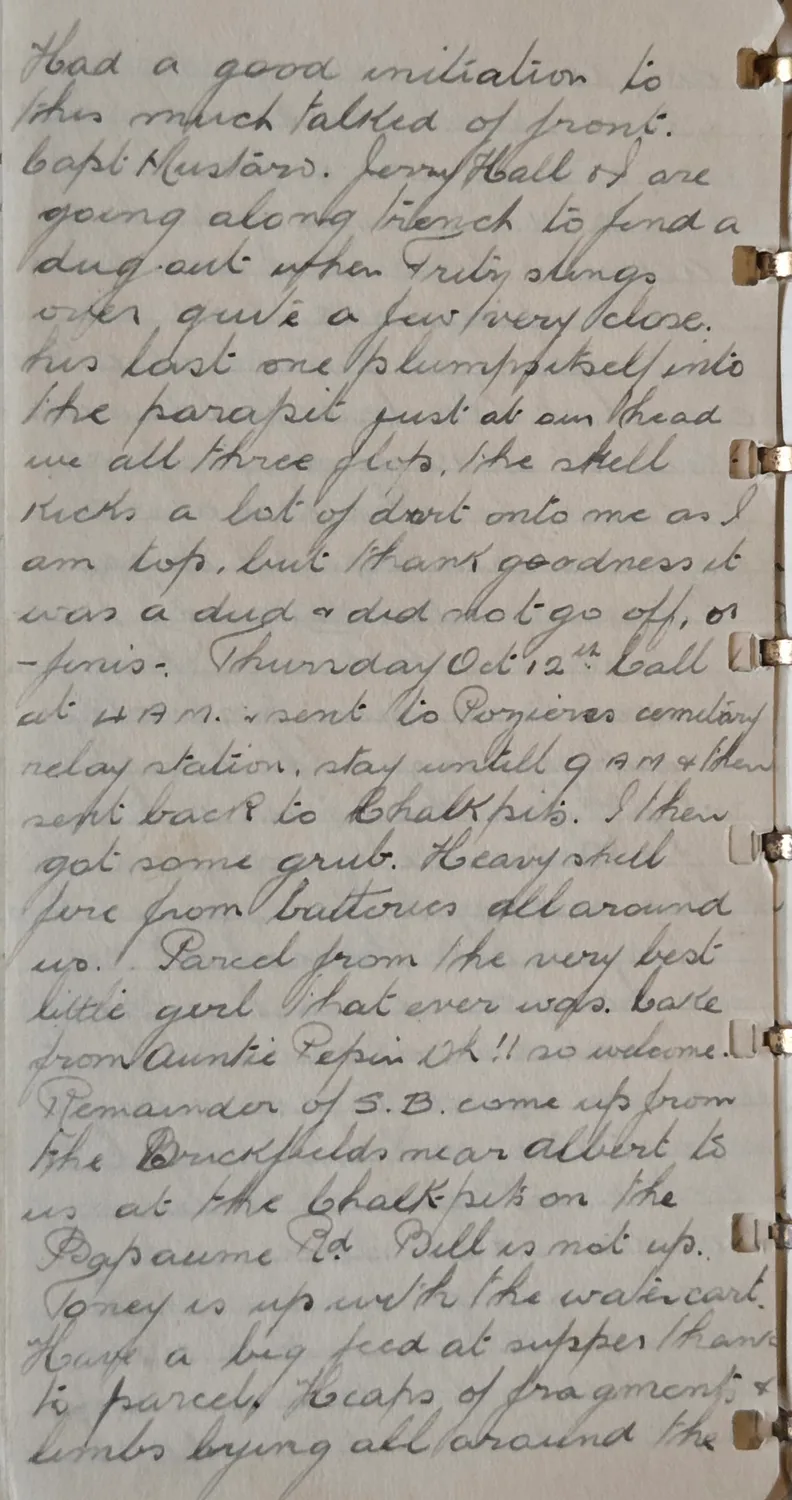
Had a good initiation to this much talked of front. Capt Mustard. Jerry Hall & I are going along trench to find a dug out when Fritz slings over quite a few very close. his last one plump itself into the parapet just at our head we all three flop, the shell kicks a lot of dirt onto me as I am top. but thank goodness it was a dud & did not go off, or - finis - Thursday Oct 12th Call at 4 AM. & sent to Pozieres cemetery relay station, stay until 9 AM & then sent back to Chalk pits. I then got some grub. Heavy shell fire from batteries all around us. Parcel from the very best little girl that ever was. cake from Auntie Pepin Oh!! so welcome.

Remainder of S.B. come up from the Brickfields near Albert, to us at the Chalk pits on the Bapaume Rd. Bill is not up. Toney is up with the water cart. Have a big feed at supper thanks to parcels. Heaps of fragments & limbs lying all around the
Where was he?
The war at this time

The mud begins

By mid-October 1916, the Somme's supply infrastructure was failing. A single British division required roughly 200 tons of supplies per day (food, water, ammunition, timber, wire, and medical stores), all of which had to reach the forward area from railheads at Albert and other rear points. The pre-war roads in the Albert-Bapaume corridor had been built for farm traffic, not sustained military use, and three months of heavy lorry convoys and constant shelling had reduced them to tracks of liquid chalk and clay. Road repair parties laid timber, brick rubble, and fascines around the clock, but the surface broke up faster than it could be mended. Light railways, which were meant to bridge the gap between railhead and front line, had not yet been extended far enough forward to help. Pack mules became the primary means of moving supplies through the worst stretches, but losses among transport animals were severe. An estimated 25 percent of pack animals on the Somme were killed or incapacitated during the autumn. Carrying parties of infantry, already exhausted from fighting, were routinely pulled from rest to haul ammunition and rations forward on their backs, a round trip that could take an entire night for a distance of barely two miles.