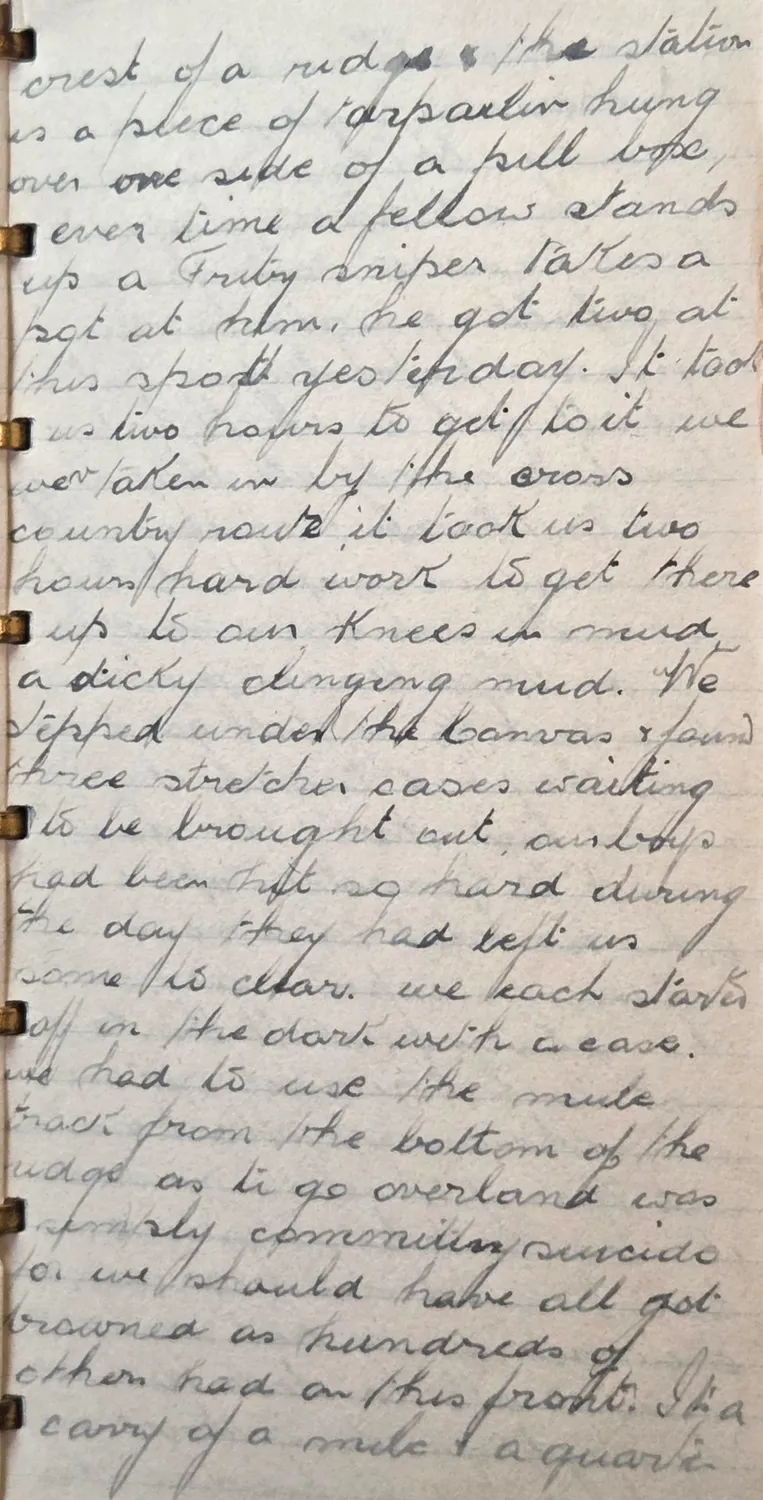
crest of a ridge + the station is a piece of tarpaulin hung over one side of a pill box, every time a fellow stands up a Fritz sniper takes a pot at him. He got two at this sport yesterday. It took us two hours to get to it we were taken in by the cross country route it took us two hours hard work to get there up to our knees in mud a sticky clinging mud. We stepped under the canvas + found three stretcher cases waiting to be brought out, our boys had been hit so hard during the day they had left us some to clear. we each started off in the dark with a case. we had to use the mule track from the bottom of the ridge as to go overland was simply committing suicide for we should have all got drowned as hundreds of others had on this front. It’s a carry of a mile + a quarter
▸ Where was he?
▸ The war at this time
Stretcher evacuation logistics at Passchendaele
Under normal trench conditions on the Western Front, four stretcher bearers could carry one casualty to the rear. At Passchendaele, the mud made this impossible. Medical records from the Canadian Corps show that eight to sixteen bearers were routinely required per casualty, working in relays because men sank to their knees or waists and exhausted themselves within a few hundred yards. A single carry from the Regimental Aid Post to the Advanced Dressing Station -- roughly a mile and a half -- could take six to eight hours. During the October and November 1917 operations, the Canadian Corps suffered approximately 15,600 casualties; the stretcher bearer sections themselves took heavy losses, with some field ambulance units reporting 30 to 40 percent casualties among bearer personnel over the course of the battle. The Canadian Corps' engineering units attempted to mitigate the problem by laying duckboard tracks -- narrow wooden walkways built on frames above the mud. By late October, several miles of duckboard had been laid across the salient, but the tracks were only one stretcher wide, forcing bearers into single file under German artillery observation. Shells regularly destroyed sections that took days to rebuild. The Corps also operated a light tramway system closer to the rear, but it could not extend into the forward zone. The medical consequences of prolonged evacuation were severe. Wound infection rates climbed sharply when treatment was delayed beyond six hours, and at Passchendaele many casualties did not reach a surgical station for twelve hours or more. Gas gangrene, caused by soil bacteria entering open wounds, was a particular danger in the contaminated Flanders mud. Canadian medical officers estimated that rapid evacuation could have saved a significant number of the men who died of wounds during the battle, but the terrain made faster movement physically impossible.