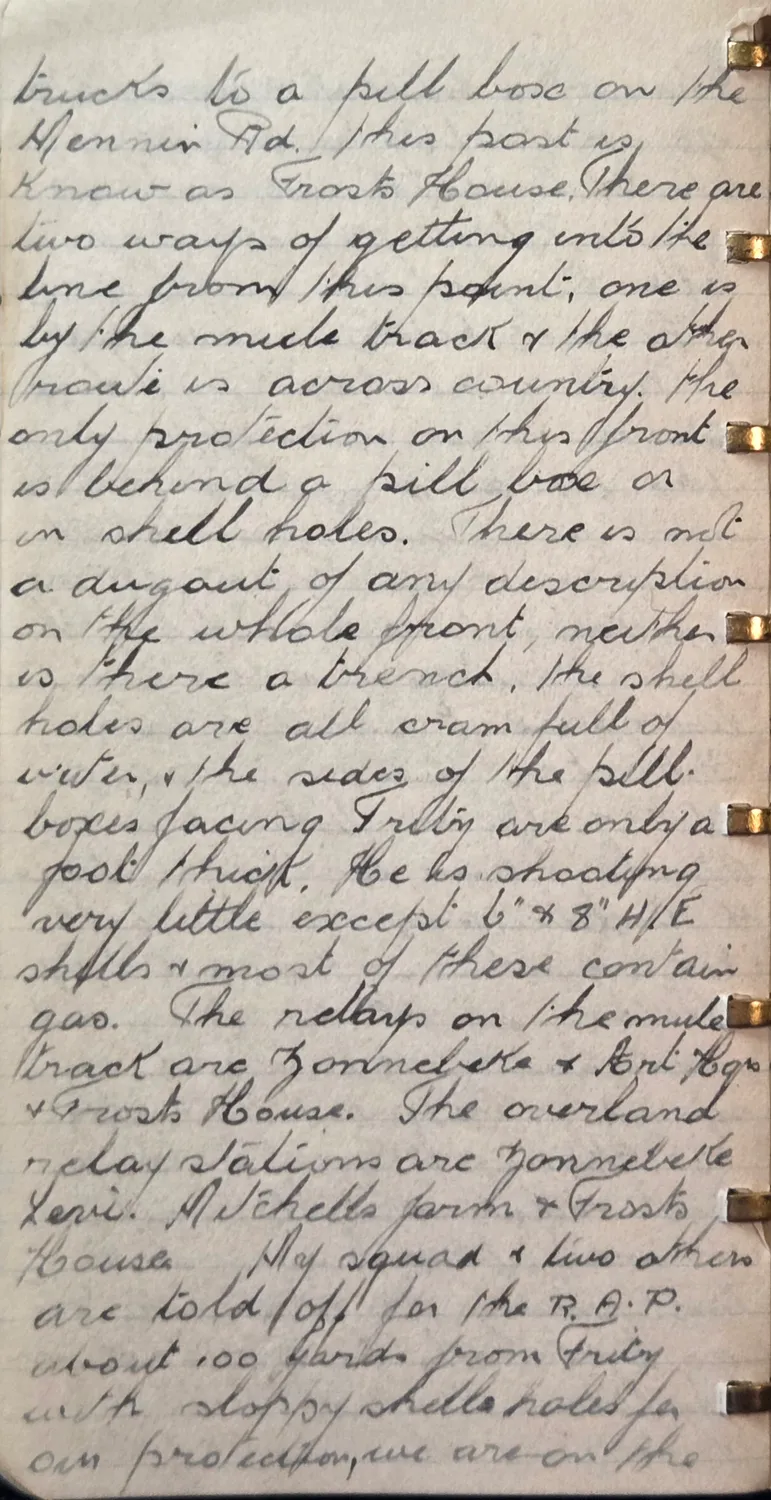
trucks to a pill box on the Mennin Rd. This post is know as Frosts House. There are two ways of getting into the line from this point; one is by the mule track + the other route is across country. The only protection on this front is behind a pill box or in shell holes. There is not a dugout of any description on the whole front, neither is there a trench. the shell holes are all cram full of water, + the sides of the pill boxes facing Fritz are only a foot thick. He is shooting very little except 6” + 8” H/E shells + most of these contain gas. The relays on the mule track are Zonnebeke + Krit Kpg + Frosts House. The overland relay stations are Zonnebeke Levi Mitchells farm + Frosts House My squad + two others are told off for the R.A.P. about 100 yards from Fritz with sloppy shell holes for our protection, we are on the
▸ Where was he?
▸ The war at this time
The German pillbox system in Flanders
Beginning in late 1916, the German Army constructed an estimated 3,000 to 4,000 reinforced concrete shelters across the Ypres salient as part of its Flandern-Stellung defensive line. Construction crews poured concrete into prefabricated steel forms, producing structures with walls up to 1.5 meters thick on the sides facing Allied lines. The rear walls were left much thinner to save materials and because they faced friendly territory. Each pillbox could shelter a squad of eight to twelve men. The Germans sited them in depth, in mutually supporting clusters so that attacking infantry who bypassed one position would come under fire from several others. This system was a deliberate adaptation to the waterlogged terrain of Flanders, where conventional trenches collapsed and flooded within hours. The German defense-in-depth doctrine accepted that forward positions might be overrun and relied on counterattack divisions held behind the ridge to retake lost ground. Pillboxes gave the forward garrison enough protection to survive artillery bombardments and delay an advance, buying time for the counterattack forces to deploy. British and Canadian units developed specific assault tactics in response. Lewis gun teams would lay suppressing fire against a pillbox's firing slits from the front while a flanking section worked around to the thin rear wall, where grenades or direct fire could penetrate. By October 1917, Canadian Corps training emphasized these techniques, but executing them under fire across open mud with no cover between positions remained extraordinarily costly.