← Previous

Wednesday, June 6, 1917

Page 106
Next →

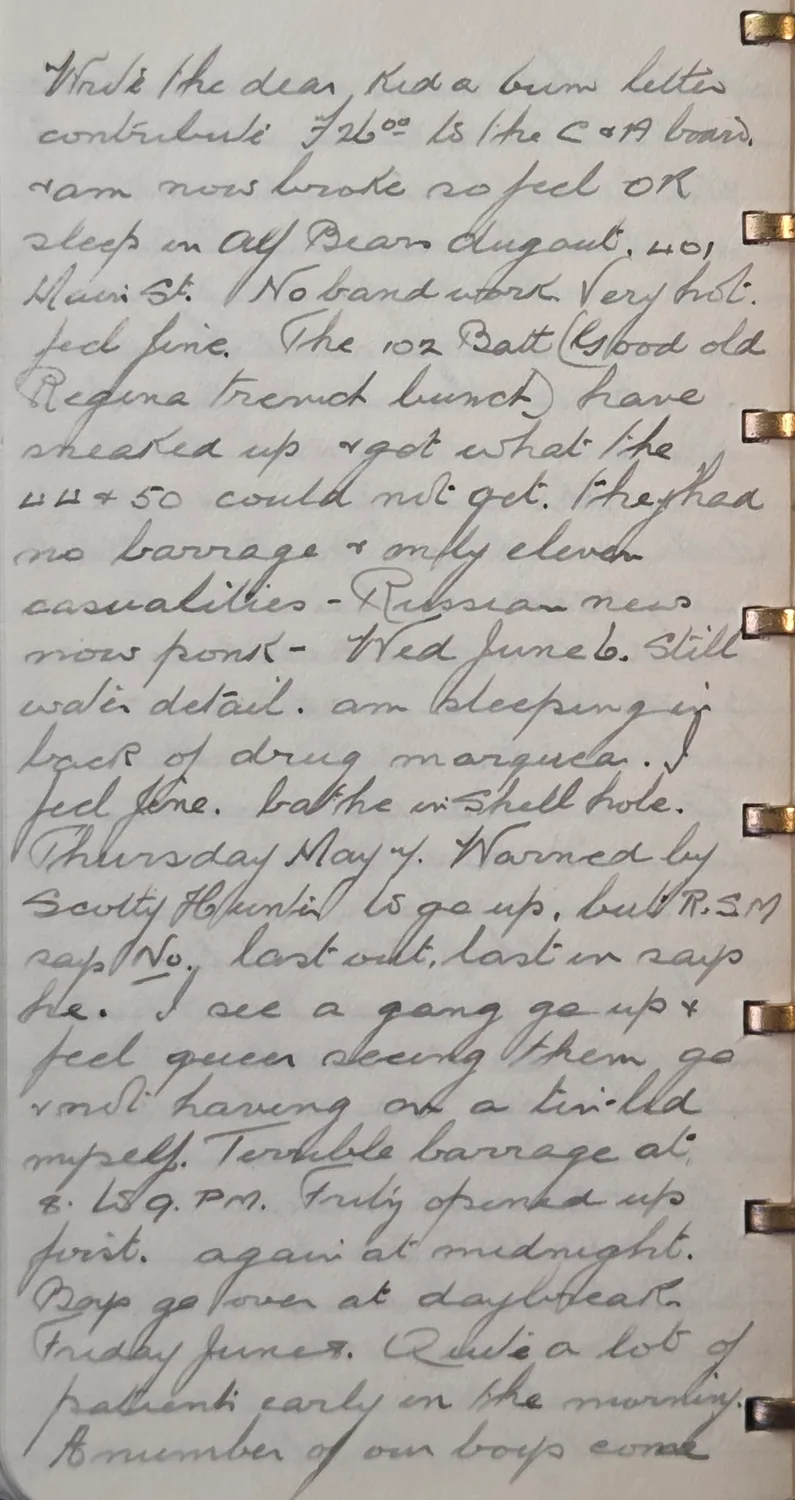
Writ the dear kid a bum letter contribute $26.00 to the C + A board. + am now broke so feel OK sleep in Alf Beans dugout, 401 Main St. No band work Very hot. feel fine. The 102 Batt (Good old Regina trench bunch) have sneaked up + got what the 44 + 50 could not get. they had no barrage + only eleven casualties - Russian news now poor - Wed June 6. Still water detail. am sleeping in back of drug marquea. I feel fine. bathe in shell hole.

Thursday May 7. [June 7] Warned by Scotty Huntir to go up, but R.S.M says No, last out, last in says he. I see a gang go up + feel queer seeing them go + not having on a tin lid myself. Terrible barrage at 8:15 9 PM. Fritz opened up first. again at midnight. Boys go over at daybreak. Friday June 8. Quite a lot of patients early in the morning. A number of our boys come
Where was he?
The war at this time

The 102nd Battalion's stealth attack and the Canadian role at Messines

After the 44th and 50th Battalions' costly failure at La Coulotte, the 102nd Battalion (North British Columbians) took a different approach. Rather than mounting a set-piece assault preceded by a conventional artillery barrage (which had alerted the German defenders and allowed them to prepare), the 102nd opted for a surprise infiltration. They advanced quietly, without preliminary bombardment, relying on stealth to close with the German positions before being detected. The tactic succeeded: the 102nd seized the La Coulotte objectives with minimal casualties, demonstrating that flexible, adaptive tactics could achieve what brute-force methods could not in the fortified terrain around Lens. On June 7, 1917, the Battle of Messines began about twenty-five miles to the north near Ypres, where British, Australian, and New Zealand forces attacked the Messines Ridge. But the Canadian Corps, positioned in the Vimy-Lens sector, had a critical supporting role to play. To prevent the Germans from shifting reserves northward to reinforce Messines, the Canadian Corps was ordered to mount aggressive diversionary operations (heavy artillery bombardments, trench raids, and demonstrations of force) that would convince the German command that a major attack was also imminent at Lens. The intense barrages that Canadian units fired on the evening of June 7 and into June 8 were part of this coordinated deception. German artillery responded in kind, and the resulting exchanges produced real casualties on both sides. For the men at medical posts behind the Canadian lines, the diversionary bombardments meant a fresh influx of wounded: the human cost of a supporting operation that would barely register in most accounts of the Battle of Messines.