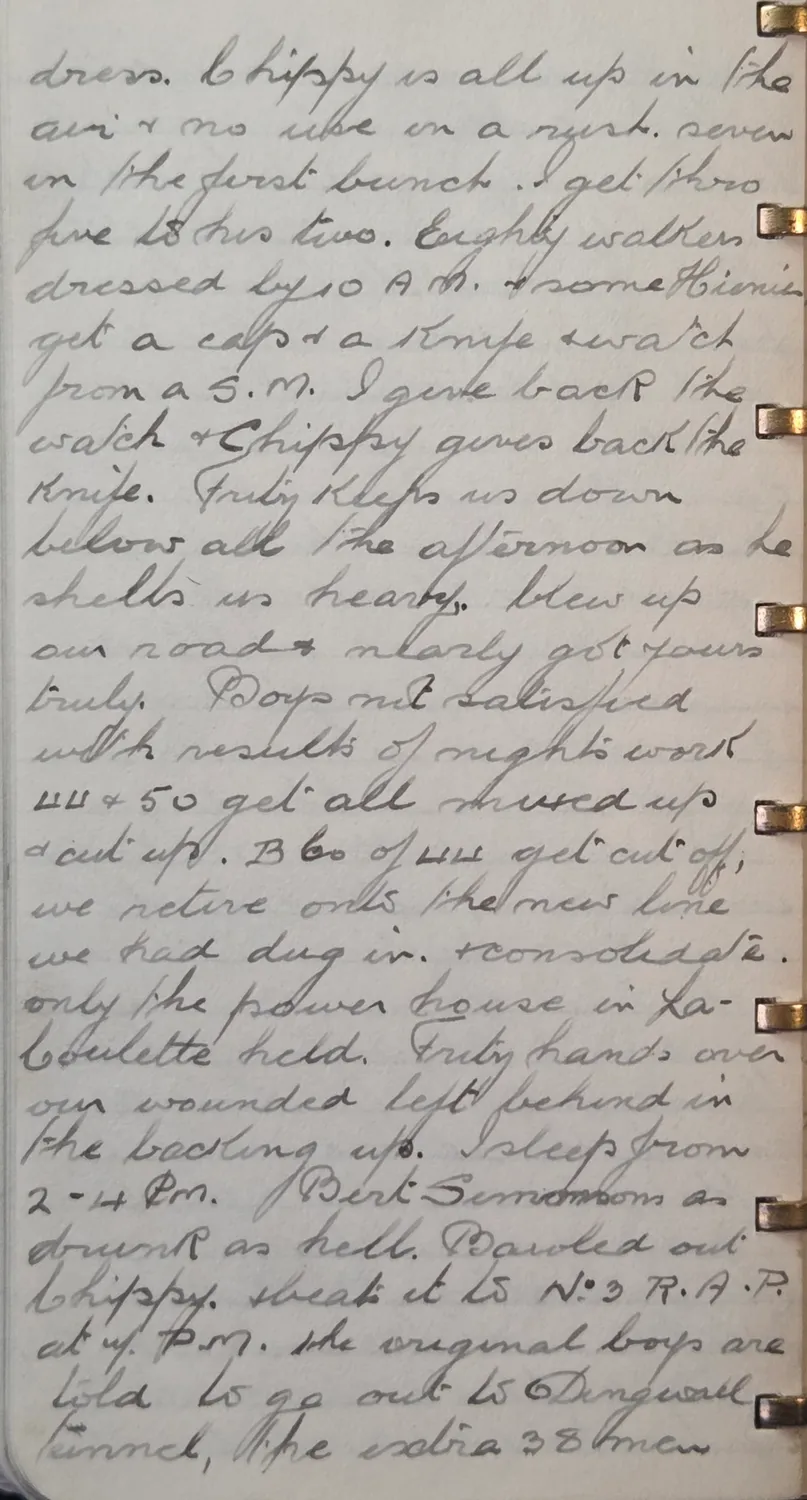
dress. Chippy is all up in the air + no use on a rush. seven in the first bunch. I get thro five to his two. Eighty walkers dressed by 10 A.M. + some Hienie get a cap + a knife + watch from a S.M. I give back the watch + Chippy gives back the knife. Fritz keeps us down below all the afternoon as he shells us heavy. blew up our road + nearly got yours truly. Boys not satisfied with results of nights work 44 + 50 get all mixed up + cut up. B Co of 44 get cut off, we retire onto the new line we had dug in. + consolidate. only the power house in La Coulette held. Fritz hands over our wounded left behind in the backing up. I sleep from 2-4 PM. Bert Simmons as drunk as hell. Bawled out Chippy. Sneak it to No 3 R.A.P. at 4 P.M. the original boys are told to go out to Dingwall tunnel, the extra 38 men
▸ Where was he?
▸ The war at this time
The failed La Coulotte attack
In early June 1917, the Canadian 10th Brigade launched an assault on La Coulotte, one of the fortified mining suburbs ringing the city of Lens. The attack was part of the broader Canadian effort to exploit the gains of Vimy Ridge by pushing eastward toward Lens itself. La Coulotte and the neighboring community of Lievin presented formidable defensive positions: the landscape was studded with slag heaps that served as natural strongpoints, mine buildings with thick walls, and cellars that the Germans had converted into deep bunkers resistant to artillery fire. The 44th Battalion (Manitoba) and 50th Battalion (Alberta) were tasked with the assault but ran into severe difficulties. The two battalions became intermixed in the maze of ruined buildings, trenches, and slag heaps, making coordinated movement nearly impossible. German defenders, firing from prepared positions in cellars and behind mine infrastructure, inflicted heavy casualties. Communication between companies broke down, and units lost contact with their flanks. Facing mounting losses and disorganization, the brigade command made the decision to pull back and consolidate on a shorter, more defensible line rather than continue pressing a failing attack. Only the power house at La Coulotte was retained as an advanced position. The Germans, in a notable act during a period of bitter fighting, returned Canadian wounded who had been left behind during the withdrawal. The failed assault underscored the difficulty of attacking fortified urban terrain without overwhelming fire support.