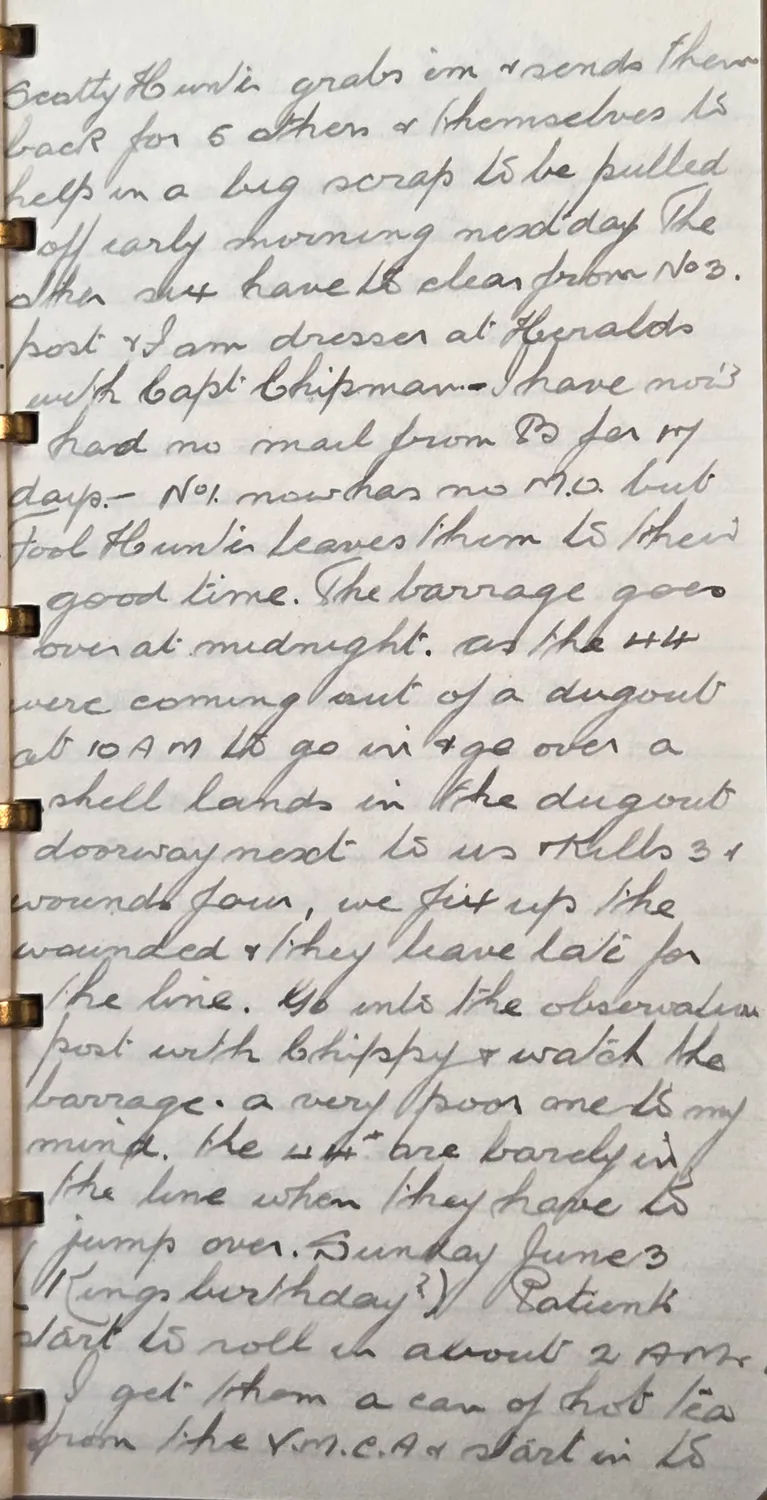
Scotty Huntir grabs em + sends them back for 5 others + themselves to help in a big scrap to be pulled off early morning next day The other six have to clear from No 3. post + I am dresser at Heralds with Capt Chipman. I have now had no mail from B for 17 days. — No 1. now has no M.O. but fool Huntir leaves them to their good time. The barrage goes over at midnight. as the 44 were coming out of a dugout at 10 AM to go in + go over a shell lands in the dugout doorway next to us + kills 3 + wounds four, we fix up the wounded + they leave late for the line. Go into the observation post with Chippy + watch the barrage: a very poor one to my mind. the 44th are barely in the line when they have to jump over. Sunday June 3 (Kings birthday?) Patients start to roll in about 2 AM. I get them a can of hot tea from the Y.M.C.A + start in to
▸ Where was he?
▸ The war at this time
Canadian attacks toward La Coulotte and Lens, June 1917
After the capture of Vimy Ridge on April 9, 1917, the Canadian Corps spent the following weeks pushing eastward toward the coal-mining city of Lens. The German defenders fell back to a series of fortified mining suburbs (La Coulotte, Avion, and Eleu-dit-Leauwette) that ringed the western approaches to the city. These were not open ground but dense clusters of miners' cottages, slag heaps, pit heads, and cellars that the Germans converted into strongpoints with interlocking fields of machine-gun fire. Each block of ruined houses became a miniature fortress. The attacks in early June 1917 were part of what the Corps termed "tidying up" operations: limited-objective assaults meant to straighten the line and secure jumping-off positions for a larger push on Lens itself. The 44th Battalion (Manitoba), part of the 10th Brigade of the 4th Canadian Division, was among the units committed to these actions. The 10th Brigade had been rotated into the line specifically for the La Coulotte sector. These operations were planned on short timelines, and battalions sometimes arrived in the forward trenches with little time to reconnoitre before going over the top. Artillery support for these smaller attacks was often thinner than for set-piece battles, and coordination between the barrage and the infantry was difficult when units were still moving into position at zero hour. The post-Vimy operations toward Lens proved unexpectedly costly. The fortified suburbs channelled attacking infantry into killing zones, and German counterattack doctrine in this sector was aggressive; local reserves were positioned to strike back within hours. For medical units, these actions generated a pattern of casualties that arrived in sudden waves rather than a steady flow, as entire platoons could be caught by shellfire in the cramped approach trenches before the assault even began.