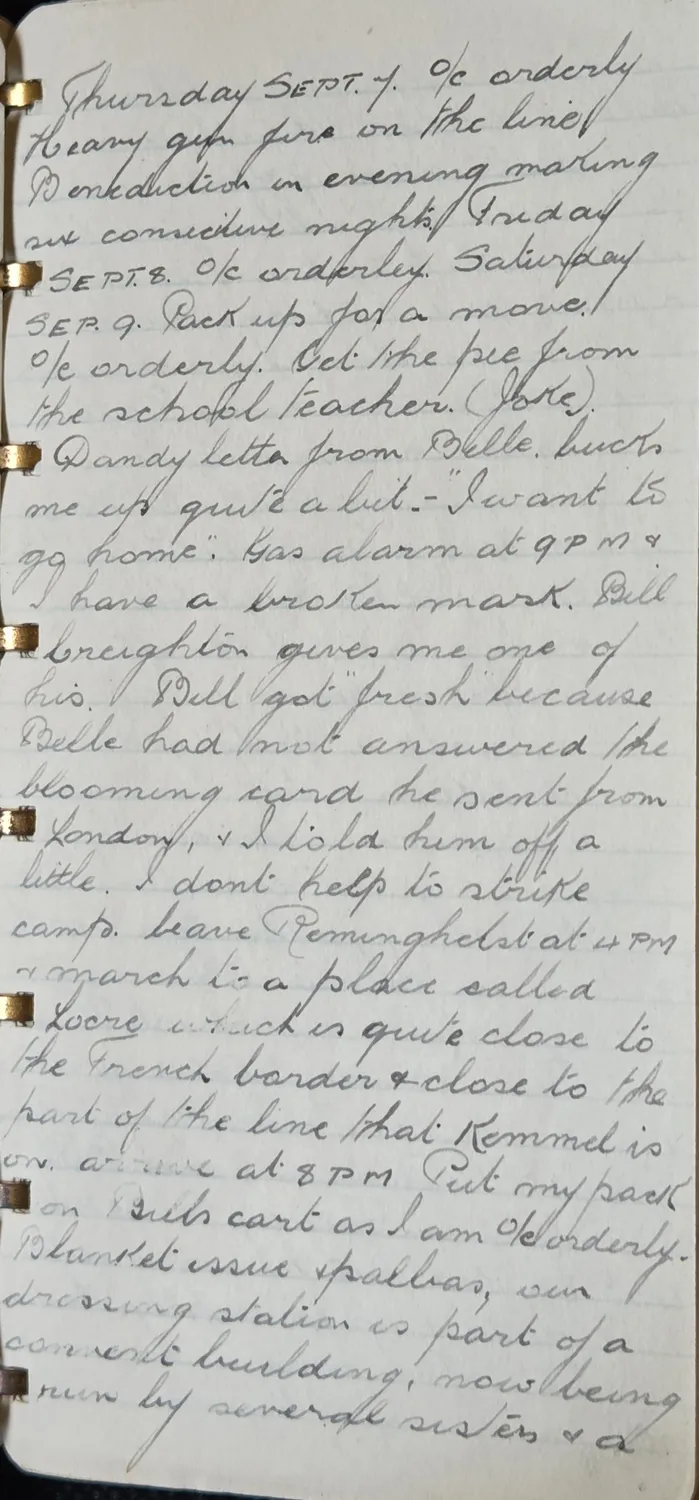
Thursday SEPT. 7. O/c orderly Heavy gun fire on the line. Benediction in evening making six consecutive nights Friday SEPT. 8. O/c orderly. Saturday SEP. 9. Pack up for a move. O/c orderly. Get the pie from the school teacher. (Joke). Dandy letter from Belle. bucks me up quite a bit. - “I want to go home”. Gas alarm at 9 PM & I have a broken mask. Bill Creighton gives me one of his. Bill got “fresh” because Belle had not answered the blooming card he sent from London, & I told him off a little. I don’t help to strike camp. Leave Reminghelst at 4 PM & march to a place called Locre which is quite close to the French border & close to the part of the line that Kemmel is on. arrive at 8 PM Put my pack on Bills cart as I am O/c orderly. Blanket issue & palliass, our dressing station is part of a convent building, now being run by several sisters & a
▸ Where was he?
▸ The war at this time
Locre and the requisition of Belgian civilian buildings
Locre (now Loker) was a small commune of roughly 2,000 inhabitants in 1914, situated on the main road between Bailleul and Ypres. Its location made it valuable to the military: it sat at a junction of paved roads capable of bearing ambulance and supply traffic, and it was close enough to the front to minimize evacuation time but far enough back (about 7 kilometres) to be out of range of most German field artillery. Mont Kemmel, the dominant terrain feature in the area at 154 metres elevation, provided observation over the entire sector, making the villages in its shadow logical sites for medical and logistics infrastructure. The British Army requisitioned Belgian civilian buildings under a formal billeting system governed by agreements with the Belgian government. Requisition officers assessed available space and assigned troops accordingly, with civilian owners entitled to compensation at fixed rates. Religious institutions such as the convent at Locre were particularly sought after as medical stations because they offered large interior rooms suitable for patient care, stone or brick construction that provided some protection from shrapnel, and existing water supplies. The convent at Locre (the Convent of St. Antoine) served as a hospice and was used by field ambulances throughout the war. The religious community remained in place despite the military occupation of their buildings, continuing their religious life and sometimes assisting with nursing duties.