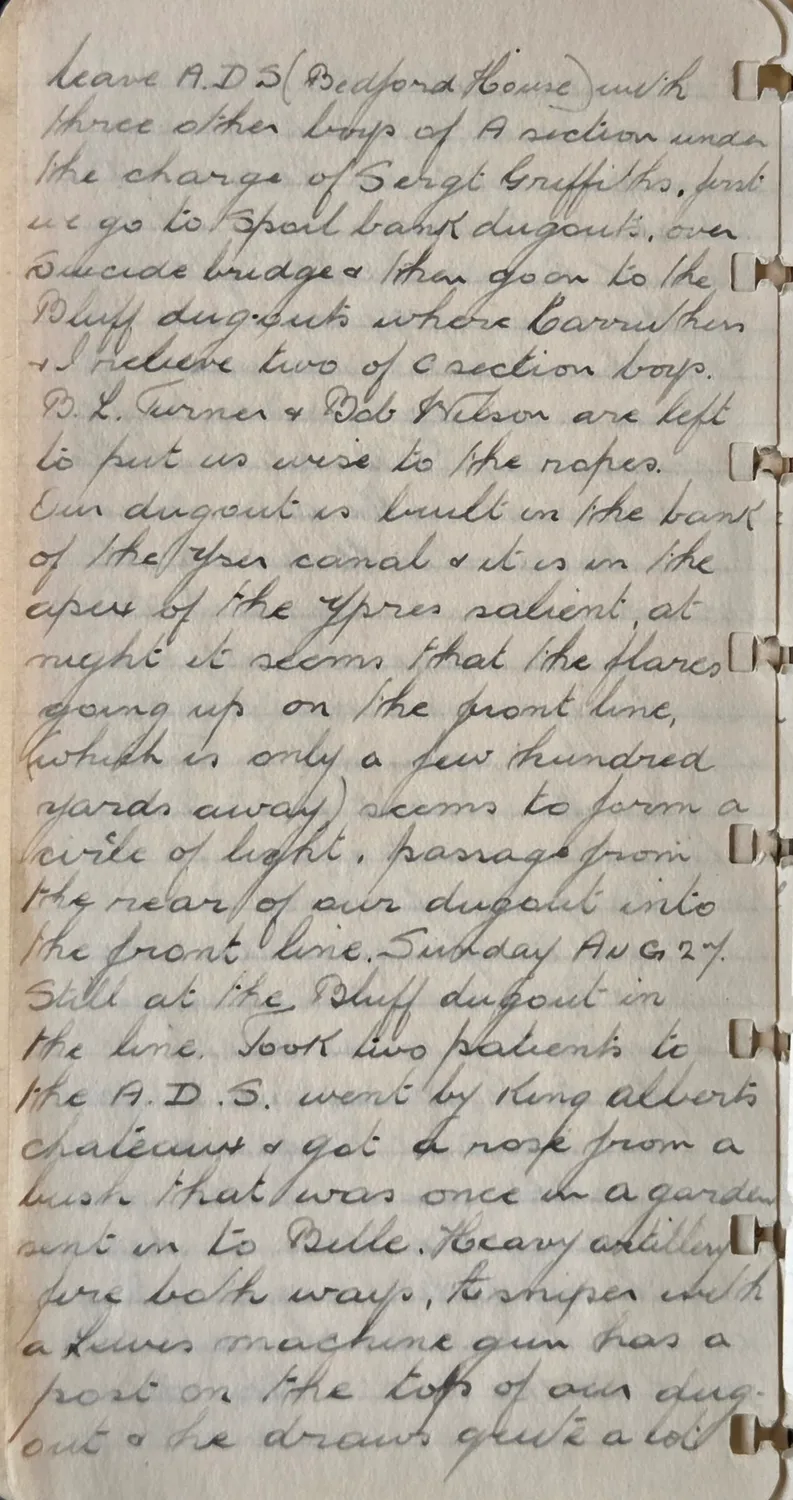
leave A.D.S (Bedford House) with three other boys of A section under the charge of Sergt Griffiths. first we go to Spoil bank dugouts, over Suicide bridge & then down to the Bluff dug-outs where Carruthers & I relieve two of C section boys. B.L. Turner & Bob Wilson are left to put us wise to the ropes. Our dugout is built in the bank of the Yser canal & it is in the apex of the Ypres salient, at night it seems that the flares going up on the front line, which is only a few hundred yards away) seems to form a circle of light. passage from the rear of our dugout into the front line. Sunday AUG 27. Still at the Bluff dugout in the line. Took two patients to the A.D.S. went by King Alberts chateau & got a rose from a bush that was once in a garden sent in to Belle. Heavy artillery fire both ways, a sniper with a Lewis machine gun has a post on the top of our dug-out & he draws quite a lot
▸ Where was he?
▸ The war at this time
The Bluff
The Bluff is a raised position at the southern end of the Ypres Salient, where the front line follows the Ypres-Comines Canal. The Germans captured it in February 1916; the British retook it in March at heavy cost. The position forms a salient within the Salient, exposed on three sides. The fighting for the Bluff in early 1916 was among the most intense localized actions in the Salient. On February 14, German pioneers detonated a mine beneath the British positions, collapsing trenches and burying defenders before Infantry Regiment 124 stormed the crater. The 17th (Northern) Division, which held the sector, suffered 1,294 casualties in the loss and the failed counterattacks that followed over the next three days. The 76th Brigade of the 3rd Division retook the position on March 2 in a surprise assault at 4:30 AM, but at a further cost of over 1,600 casualties across both divisions. Both sides had driven tunnels through the clay beneath the canal bank, and the ground was honeycombed with shafts. By the time the diarist arrived in August, the position was nominally stable, but the tunnel networks remained active and the Germans maintained observation from higher ground to the east, making any movement above the canal bank hazardous.