← Previous

Wednesday, March 28, 1917

Page 83
Next →

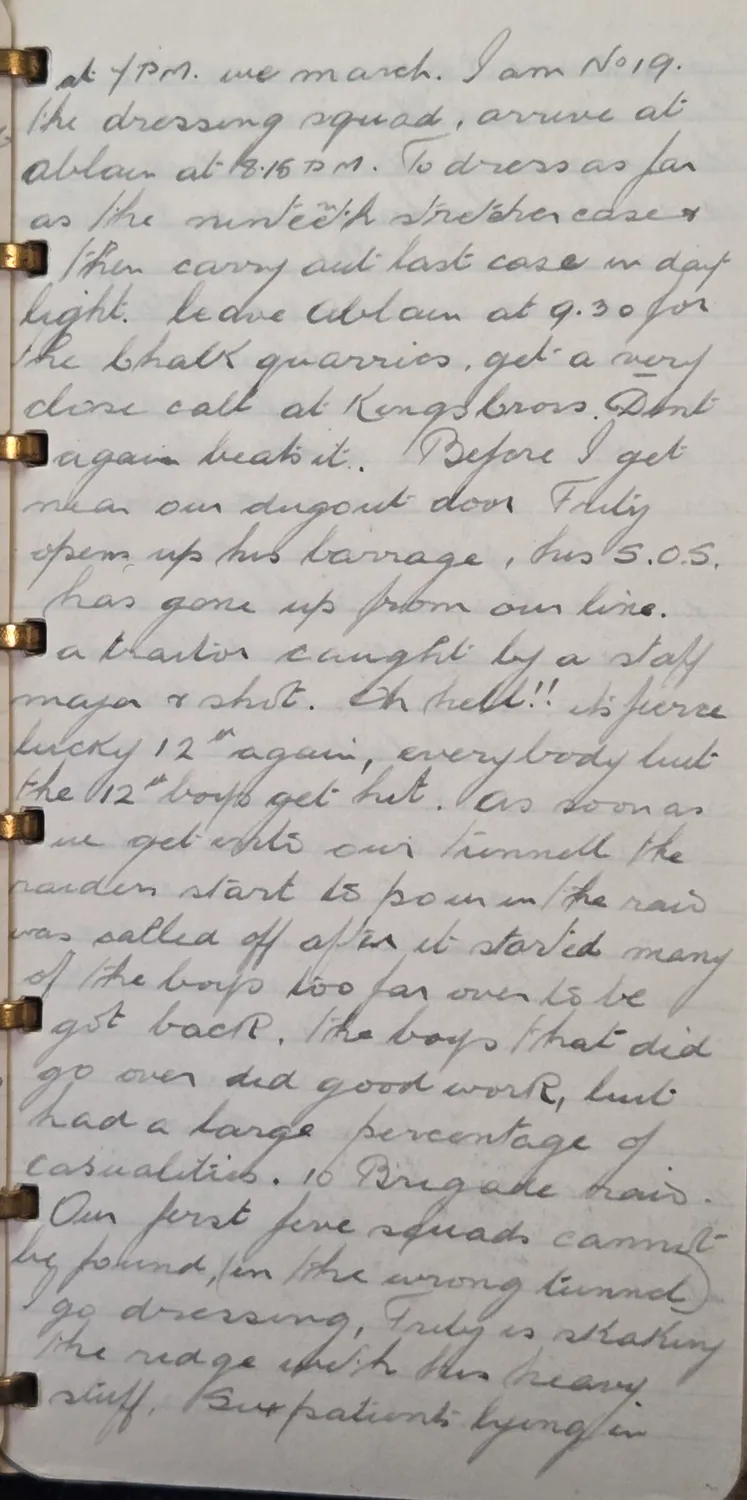
at 7 PM. we march. I am No 19. the dressing squad, arrive at Ablain at 8.15 P.M. To dress as far as the ninth stretcher case & then carry out last case in day light. leave Ablain at 9.30 for the Chalk quarries, get a very close call at Kings Cross. Dent again beats it. Before I get near our dugout door Fritz opens up his barrage, his S.O.S. has gone up from our line.

a traitor caught by a staff major & shot. Oh hell!! it’s fierce lucky 12th again, everybody but the 12th boys get hit. As soon as we get into our tunnell the raiders start to pour in the raid was called off after it started many of the boys too far over to be got back. the boys that did go over did good work, but had a large percentage of casualties. 10 Brigade raid. Our first five squads cannot be found, (in the wrong tunnel) go dressing, Fritz is shelling the ridge with his heavy stuff. Our patients lying in
Where was he?
The war at this time

Raids before the Vimy assault

In the weeks before the main assault on Vimy Ridge, the Canadian Corps conducted an intensive programme of trench raids to gather intelligence, identify German units, test defences, and keep the enemy off balance. These raids grew larger and more frequent through March 1917. The 10th Canadian Infantry Brigade was particularly active in this period. Each raid required coordination between infantry, artillery, and medical services. Between late February and early April 1917, the four Canadian divisions conducted over 55 trench raids along the Vimy front. Canadian Corps records show more than 1,400 casualties from these operations before the main assault began. The raids served a specific intelligence purpose: capturing prisoners who could be identified by unit, revealing the German order of battle opposite each attacking division. By early April, Canadian intelligence had identified every German battalion holding the ridge and most of their reserve formations. Raiders also brought back details of defensive works: the depth of wire belts, locations of machine-gun posts, and the layout of tunnel entrances. These details were incorporated into updated trench maps issued to assaulting units. The doctrinal approach treated raids as rehearsals for the set-piece battle. Artillery and infantry practised the precise coordination of creeping barrages, infantry commanders gained experience managing objectives under fire, and medical services tested their evacuation plans under realistic conditions. The cumulative intelligence and operational experience from this costly programme contributed directly to the detailed planning that made the April 9 assault on Vimy Ridge successful.