← Previous

Wednesday, December 13, 1916

Page 54
Next →

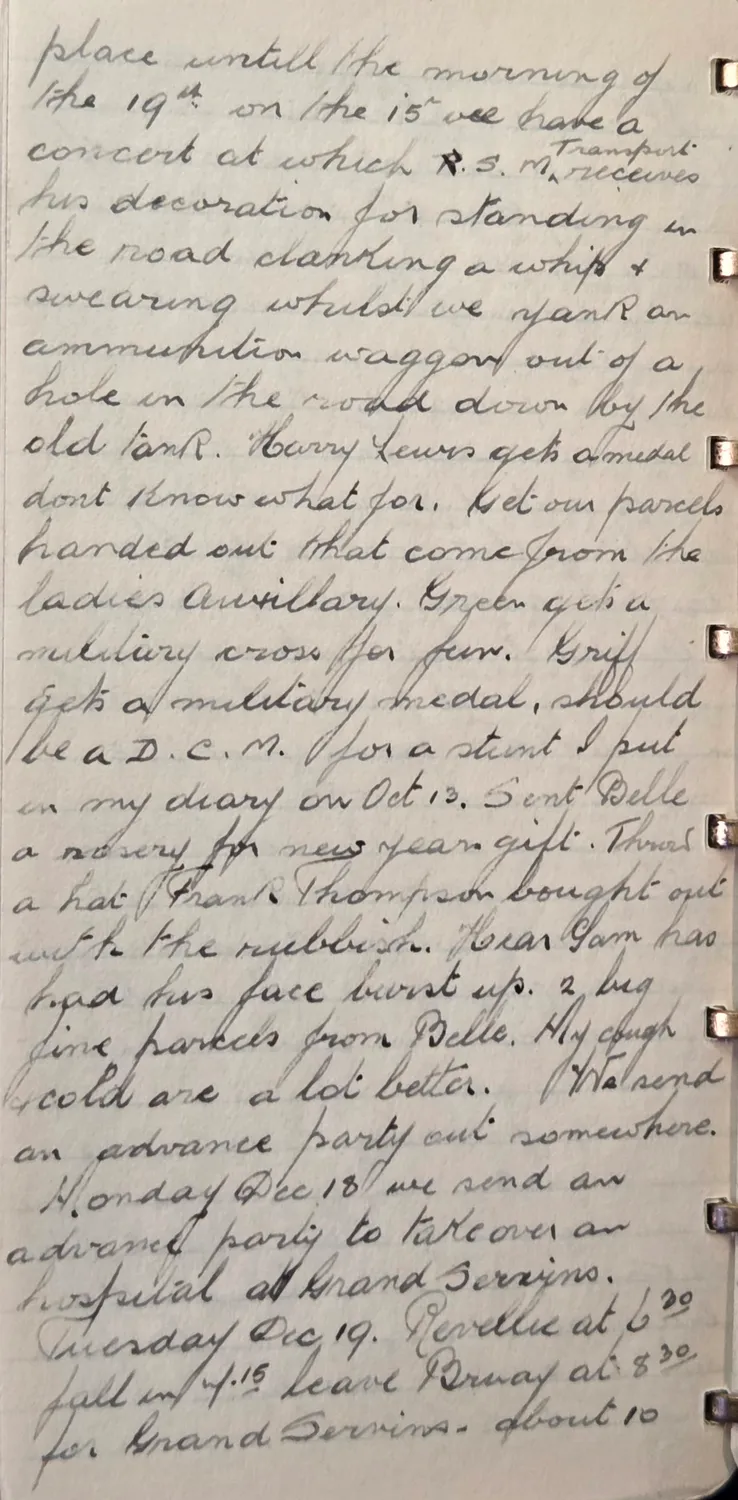
place until the morning of the 19th on the 15th we have a concert at which R.S.M. Transport receives his decoration for standing in the road clanking a whip & swearing whilst we yank an ammunition waggon out of a hole in the road down by the old tank. Harry Lewis gets a medal dont know what for. Get our parcels handed out that come from the ladies auxiliary. Greer gets a military cross for [?]ew. Griff gets a military medal, should be a D.C.M. for a stunt I put in my diary on Oct 13. Sent Belle a rosery for new year gift. Threw a hat Frank Thompson bought out with the rubbish. Hear Sam has had his face burst up. 2 big fine parcels from Belle. My cough & cold are a lot better. We send an advance party out somewhere.

Monday Dec 18 we send an advance party to take over an hospital at Grand Servins. Tuesday Dec 19. Reveille at 6.30 fall in 7.15 leave Bruay at 8.30 for Grand Servins. about 10
Where was he?
The war at this time

The gallantry awards system and its controversies

The process for awarding gallantry medals in the Canadian Expeditionary Force followed British Army procedure. A nomination typically began with an officer who witnessed or was told of the act, who wrote a citation and forwarded it up the chain of command. For the Military Medal (MM), approval rested at the divisional level; for the Distinguished Conduct Medal (DCM), it went to Corps or Army headquarters; the Military Cross (MC) was reserved for officers and warrant officers. At each level, staff officers who had not witnessed the action decided whether to approve, downgrade, or reject the recommendation. A nomination for a DCM could be reduced to an MM without explanation to the nominee or his unit. This system generated persistent resentment in the ranks. Soldiers close to the action often felt that awards reflected proximity to officers who wrote citations rather than the actual merit of the deed. Men who served in headquarters, transport, or other rear-area roles were more visible to the officers who initiated nominations, while front-line stretcher-bearers and infantry who performed acts of equal or greater courage went unrecognised because no officer was present to observe. During the Somme battles of 1916, the Canadian Corps awarded approximately 1,900 Military Medals but only around 230 Distinguished Conduct Medals, making the DCM significantly harder to obtain. The MM had been created only in March 1916, partly to address complaints that other ranks had too few avenues for recognition compared to officers, who had the MC, DSO, and mentions in dispatches readily available to them. The distribution of awards was also unevenly spread across unit roles. A statistical analysis of Canadian gallantry awards shows that officers received decorations at a rate per capita several times higher than other ranks. This disparity was well understood by the men at the time and contributed to a cynicism about the honours system that runs through many soldiers' diaries and letters. When a man believed a comrade deserved a DCM but saw him receive only an MM, it reinforced the perception that the system rewarded rank and connections over courage.