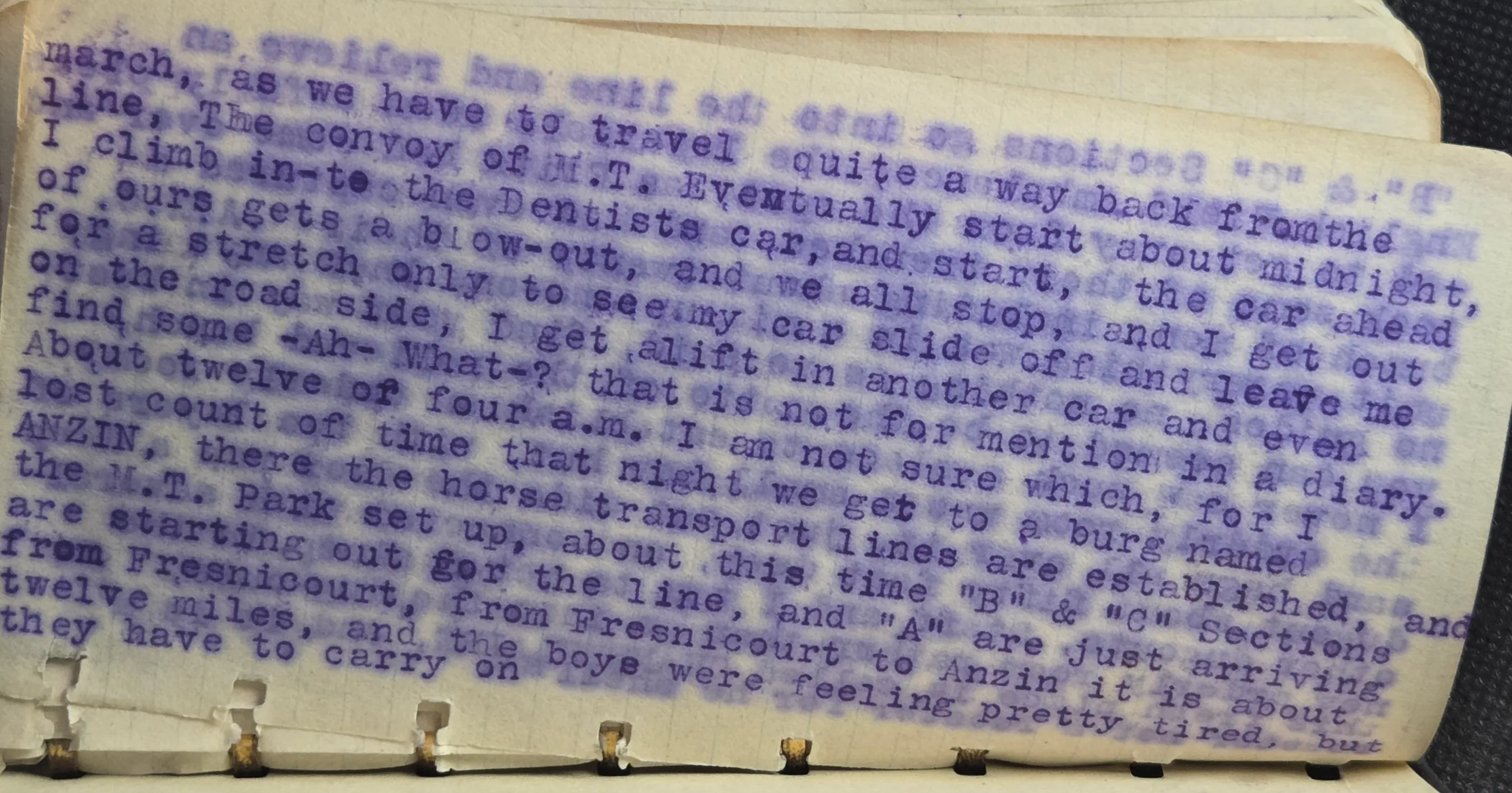
march, as we have to travel quite a way back from the line, The convoy of M.T. Eventually start about midnight, I climb in-to the Dentists car, and we all start, the car ahead of ours gets a blow-out, and we all stop, and I get out for a stretch only to see my car slide off and leave me on the road side, I get a lift in another car and even find some -Ah- What-? that is not for mention in a diary. About twelve of four a.m. I am not sure which, for I lost count of time that night we get to a burg named ANZIN, there the horse transport lines are established, and the M.T. Park set up, about this time “B” & “C” Sections are starting out for the line, and “A” are just arriving from Fresnicourt, from Fresnicourt to Anzin, it is about twelve miles, and the boys were feeling pretty tired, but they have to carry on
Thursday, May 30, 1918
Page 166▸ Where was he?
▸ The war at this time
The road to the Armistice
By late May 1918, Germany has launched three massive offensives since March 21 and advanced up to 40 miles. But none has achieved a decisive breakthrough. German losses since March are staggering and cannot be replaced. Two more offensives follow in June and July, each weaker than the last. On July 18, Foch launches a devastating counterattack on the Marne. On August 8, the Canadian Corps spearheads the Allied assault at Amiens, advancing eight miles on the first day. Ludendorff calls it 'the black day of the German Army.' The Hundred Days Offensive begins. The Canadian Corps fights at the sharp end, breaking the Drocourt-Quéant Line on September 2, crossing the Canal du Nord on September 27, liberating Cambrai in October, and capturing Valenciennes on November 1. Germany's allies collapse: Bulgaria in September, the Ottoman Empire in October, Austria-Hungary in November. On November 11, 1918, at 11:00 a.m., the guns fall silent. The war is over.