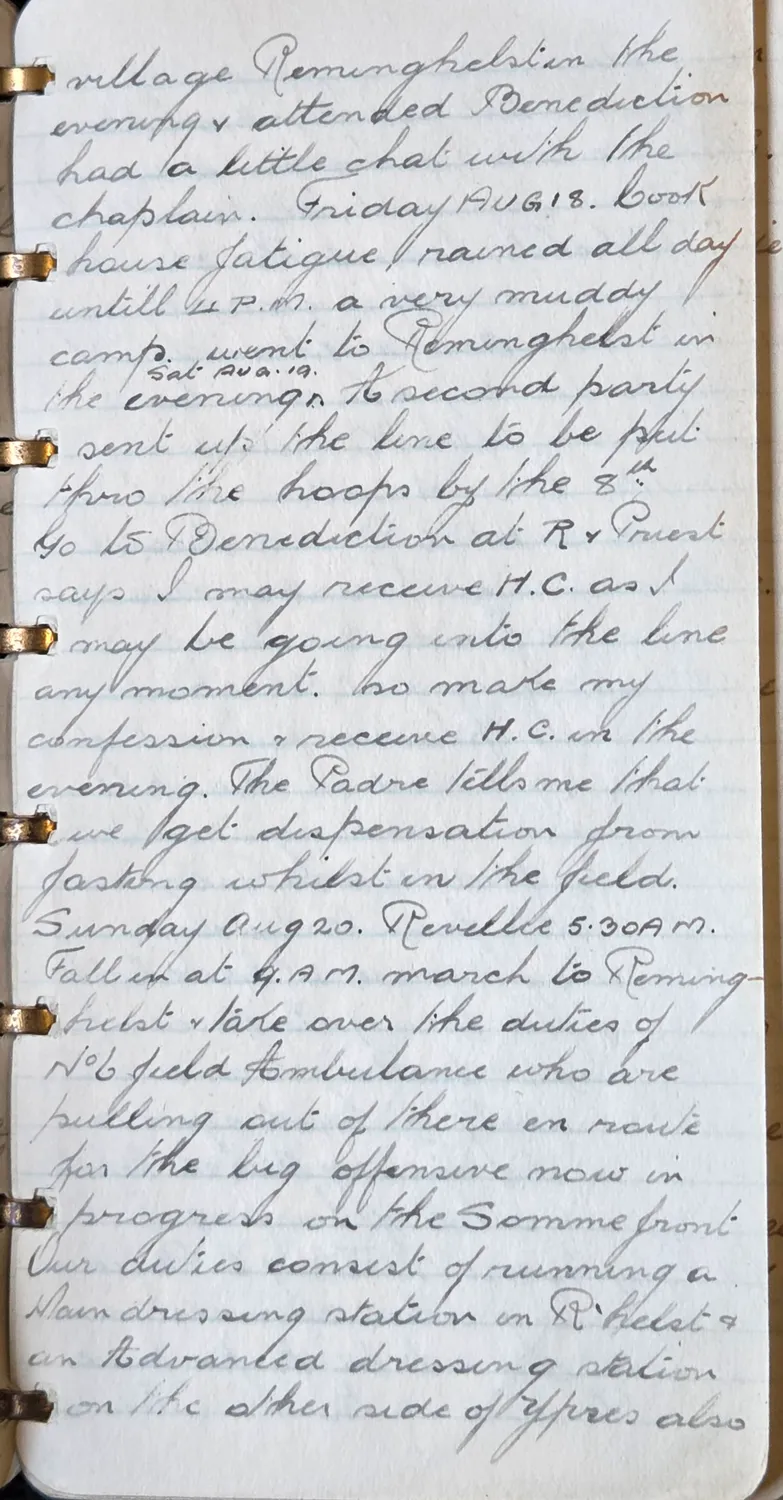
village Reminghelst in the evening & attended Benediction had a little chat with the chaplain. Friday AUG 18. Cook house fatigue rained all day until 4 P.M. a very muddy camp. went to Reminghelst in the evening. Sat Aug 19. A second party sent up the line to be put thro the hoops by the 8th. Go to Benediction at R. & Priest says I may receive H.C. as I may be going into the line any moment. So make my confession & receive H.C. in the evening. The Padre tells me that we get dispensation from fasting whilst in the field. Sunday Aug 20. Reveille 5.30 AM. Fall in at 4. AM. march to Reninghelst & take over the duties of No 6 field Ambulance who are pulling out of there en route for the big offensive now in progress on the Somme front. Our duties consist of running a Main dressing station in R’helst & an Advanced dressing station on the other side of Ypres also
▸ Where was he?
▸ The war at this time
CAMC field ambulances and the Somme medical crisis
A Canadian field ambulance in 1916 was not a vehicle but a mobile medical unit of roughly 230 men organized into three sections (A, B, and C), each capable of operating independently. One section typically ran the Advanced Dressing Station near the front, another the Main Dressing Station further back, and the third rested in reserve. This structure allowed continuous medical coverage during the rotations that kept men cycling through the trenches. The Battle of the Somme, which had been raging since July 1, created an enormous demand for medical units. By mid-August 1916, Canadian casualties on the Somme were mounting rapidly. The Canadian Corps would suffer over 24,000 casualties in its Somme operations between September and November alone. To feed this demand, experienced medical units like the 6th Canadian Field Ambulance were pulled from quieter sectors such as Ypres and sent south. The 6th FA would go on to support operations at Courcelette and the Ancre Heights, where the Canadian Corps saw some of its heaviest fighting of the war. This reshuffling left the Ypres sector to be covered by units from the newly arrived 4th Canadian Division, who had to learn the local conditions quickly while the sector was relatively quiet.